A printable version of this electrochemical note is available here: IEN7 – MultiSine EIS time reduction trade-off against accuracy loss
The MultiSine EIS technique holds the promise of a measurement duration reduction, at the cost of a loss of accuracy. This note attempts to quantify how much time reduction, and how much accuracy loss.
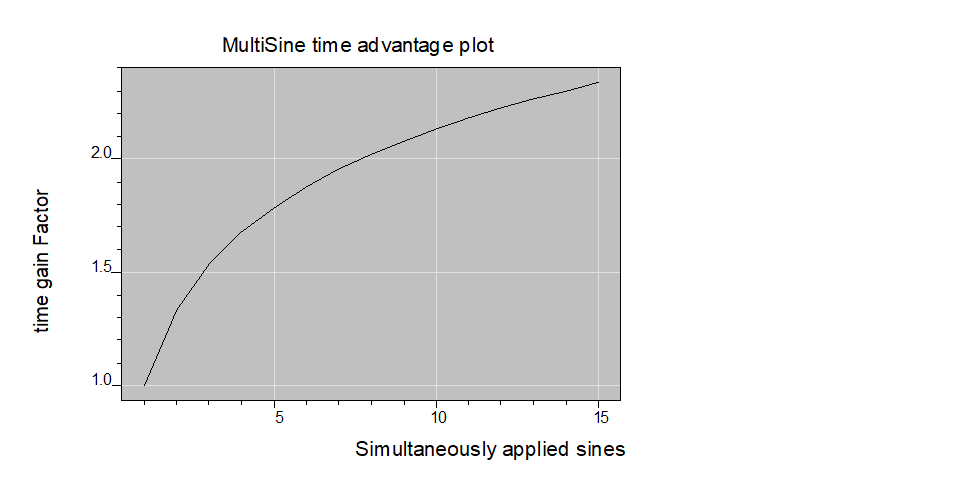
a. When doing a frequency scan the lowest frequency takes more time than the highest, so the low frequency has a higher impact on the total duration. For example, if you do 2-Sine combination of 1Hz and 3Hz, a measurement period is 1sec, while the same 1Hz-3Hz could be executed as single sine at 1.33sec (the sum of measurement periods 1+1/3). Therefore a 2-Sine approach would gain a time reduction factor of 1.33, instead of a factor of 2. See below for n-Sine cases. Note that for a factor 4 reduction, you need 400 simultaneously applied sines.
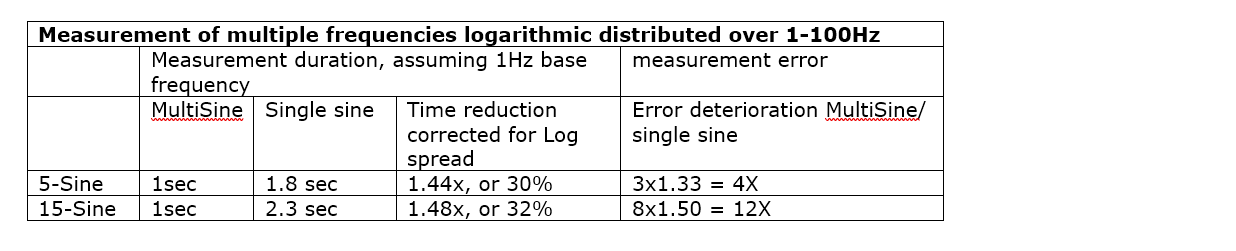
b. The MultiSine approach must apply an odd numbered frequency selection: 1-3-5-7-9-11-13-15-17-19-21-23-25-27-29Hz, etc. However, to get the desired electrochemical information from our sample, a logarithmic distribution is needed. The difference between 1Hz and 3Hz is large. On the other hand, the difference between 27Hz and 29Hz is small. If we accept that a factor 3 spacing is adequate, then we accept that a 5-MultiSine run 1-3-5-7-9 Hz is equivalent to a single-sine 1Hz-3Hz-9Hz run (5Hz and 7Hz do not give useful information and can be omitted). Such a “3 frequencies scan” would take 1.44 sec, so if we correct for frequency distribution, the 5-sine technique will reduce the measurement time with 30% (0.44/1.44). For higher N’s, the useful time gain is negligible compared to 5-Sine: for a 15-Sine run, we can get the equivalent information with just 4 single Sine measurements 1-3-9-27Hz, so the useful time reduction is only 32% (0.48/1.48).
a. When multiple sines are applied simultaneously, we need to reduce the amplitude of each single frequency. If we would keep individual frequency components at the same amplitude as in the single sine technique, the sines would add up to magnitudes that create non-linear effects. To ensure that the combined amplitude at the same level as single sine, we need to reduce each amplitude component with a factor related to the N number. If we carefully select the initial phase of each frequency component, we can optimize this (pseudo phase randomization). After optimizing for a 5-Sine experiment, we need to reduce each amplitude with a factor 3, instead of 5, while for 15-Sine about factor 8. That means that the accuracy of a 5-Sine result is 3 times worse than a single sine result, etc.
b. During a MultiSine measurement, we need to put the applied and measurement instrumentation to a wide(r) bandwidth than for MultiSine. That means, we allow more noise frequencies and dc-drift in our system. The exact impact depends on the specific situation, but it is realistic to estimate that this effect causes an (extra) 33% decrease of accuracy for a 1-decade frequency window (5 Sine), and a 50% decrease for 2-decade frequency spread (15 Sine).
If properly compared with a single sine, a 5-Sine MultiSine approach has the advantage of a 30% shorter measurement time, and the disadvantage of a factor 4 worse accuracy. MultiSines with more than 5 frequencies do not seem recommendable: the extra time reduction is marginal, whereas the loss of accuracy is proportional. Note that going from 5-Sine to 15-Sine, the (corrected) measurement duration decreases with less than 3%, at cost of a factor 3 additional loss of accuracy.