A printable version of this electrochemical note is available here: IEN5 – True linear sweeps, staircase sweeps, and current averaging
For some applications, results for normal sweeps will be different from results obtained with a true linear sweep. This note explains the reason.
In historical applications, sweeps were “true linear”. That means analog created smooth continuous sweeping applied signals. Later with the introduction of digital electronics, sweeps became the norm at which the signal is applied by stepwise increments shaped as a staircase. This had 2 reasons; it is easier to build, and it gives better performance for analytical and reaction studies. The latter is because the ratio Faradaic/Capacitive current is higher for staircase sweeps, which is desirable for most applications.
However sometimes, one is interested in the measurement of capacitive, and catalytic currents coupled with an adsorbed species. In those cases, one prefers a true linear sweep. A well-known example is the Cyclic Voltammetric Hydrogen peak, that shows up quite different for both methods.
The reason for these differences stem from the shape of the applied signal, and the timing of measurement. A staircase sweep will apply a step at the beginning of each interval and keep the voltage constant for the rest of the interval duration, while measuring the current only at the end of the interval. The capacitive process will react only on the initial step, and decay fast for the remainder of the interval, see Figure 1 below. The Faradaic process, however, will decay much slower, and will dominate the measured current at the end of the interval. For a true linear scan, the capacitive component will be constant and be a larger portion of the measured current.
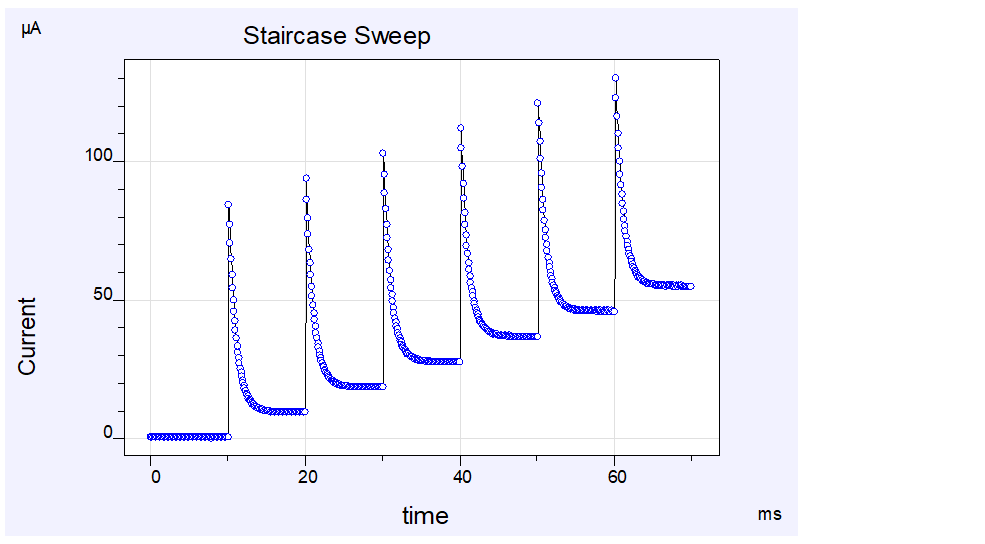
Figure 1: Realtime transient for 100mV steps on 10kOhm in series with 1µF//1kOhm parallel.
In the specific cases mentioned, a true linear sweep is preferred. However, this requires dedicated hardware. Now, there is another option, the so-called CurrentAveraging technique. For this, the signal application is as the staircase technique, but the current measurement is averaged over time. That means the total charge over the interval is integrated and calculated to a time average. Internally the current is passed through a Nyquist filter, sampled at a very high rate, and averaged. For most cases, this gives the same result as a true linear scan.