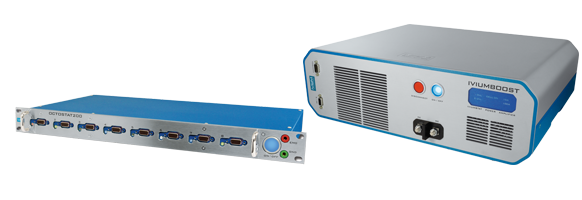
A printable version of this application note is available here: A5 – RRDE
Introduction
Ivium is currently developing a rotator for a rotating ring disk (RRDE) electrode, which can, for example, be used to study reaction mechanisms and ionic diffusion coefficients related to redox chemistry. The rotator has dual brush contacts, the rotation rates are variable between 100 and 10,000 RPM in steps of 1 RPM and it is compatible with Ivium tips as well as 3rd party tips. The rotation speed can be controlled manually from the manual control unit, or via analog output of Ivium potentiostats.
Recently, Ivium performed measurements with the RRDE rotator. In this report the results are presented.
Experimental
A CompactStat.h standard was used in combination with the RRDE rotator. The rotation speed was set manually with the standalone control unit. The measurements were carried out in a three-electrode configuration. The working electrode was an RRDE platinum ring/glassy carbon disk electrode (4 mm) from ALS, Japan. The counter electrode (CE) and reference electrode (RE) were a platinum sheet and an Ag/AgCl electrode (3M NaCl), respectively. The rotator, counter electrode and reference electrode were positioned in a 100 ml glass beaker with a standard laboratory stand. The measurements were carried out in a 0.1 M KNO3 aqueous solution containing 10 mM K3Fe(CN)6 at room temperature. A picture of the experimental setup is shown in Figure 1.
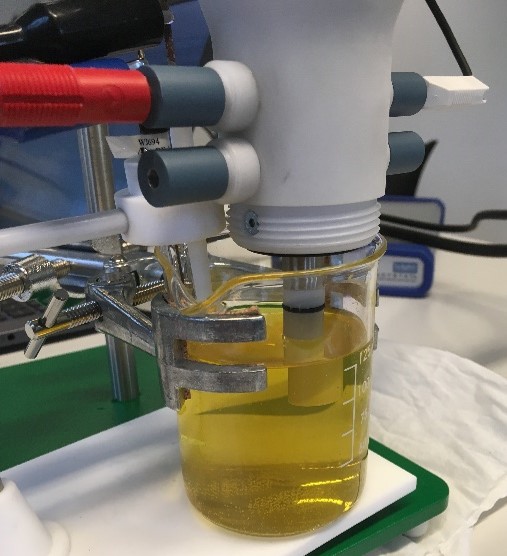
Figure 1: Photograph of the RRDE setup.
Cyclic voltammetry measurements with a scan rate of 100 mV/s and a step size of 10 mV were performed between -1.0 and 1.0 vs Ag / AgCl at various rotation rates.
Results and discussion
Figure 2 shows the results of the current response as a function of electrode rotation rate. As expected, the reduction current increases by increasing the rotation rate.
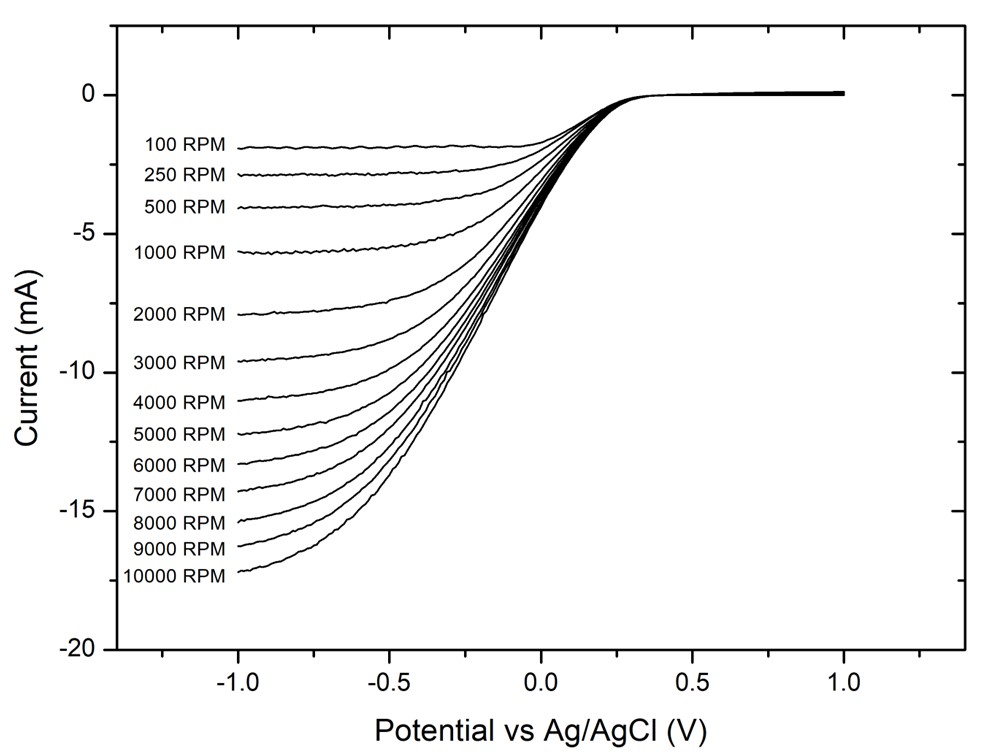
Figure 2: Cyclic voltammograms at various rotation rates at a scan rate of 100 mV/s and a step size of 10 mV.
The results obtained in the cyclic voltammetry measurements can be used to determine the diffusion coefficient of the Fe(CN)63- ion by using the Levich equation, which is given by
il = 0.62nFAD2/3ω1/2υ-1/6C0
where il is the limiting current under mass transfer controlled conditions, n is the number of electrons in the redox reaction, F is the Faraday constant, D is the diffusion coefficient, ω is the rotation rate, υ is the kinematic viscosity of the electrolyte and C0 is the concentration of the ion in the bulk of the solution.1
Figure 3 shows that the current density is indeed proportional to square root of the rotation rate as expected based on the Levich equation. From the slope of the linear fit the diffusion coefficient of the Fe(CN)63- ion is calculated to be 5.92×10⁻⁶ cm2/s. This value is close to known values such as 7.26×10⁻⁶ cm2/s in 1 M KCl at 25°C.2 Therefore, it can be concluded that the rotator works well.
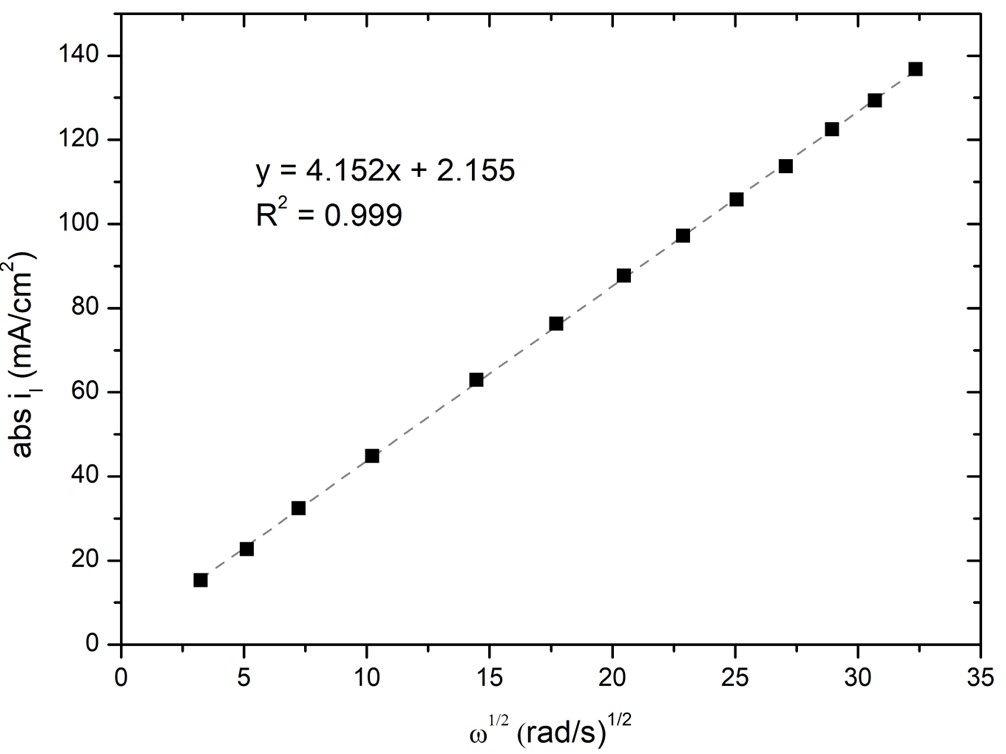
Figure 3: Levich graph of the limiting current as a function of rotation rate.
Conclusions
Preliminary results of the RRDE rotator show that the limiting current is proportional to the rotation rate satisfies the Levich equation. The calculated diffusion coefficient of the Fe(CN)63- ion is close to reported values.
References